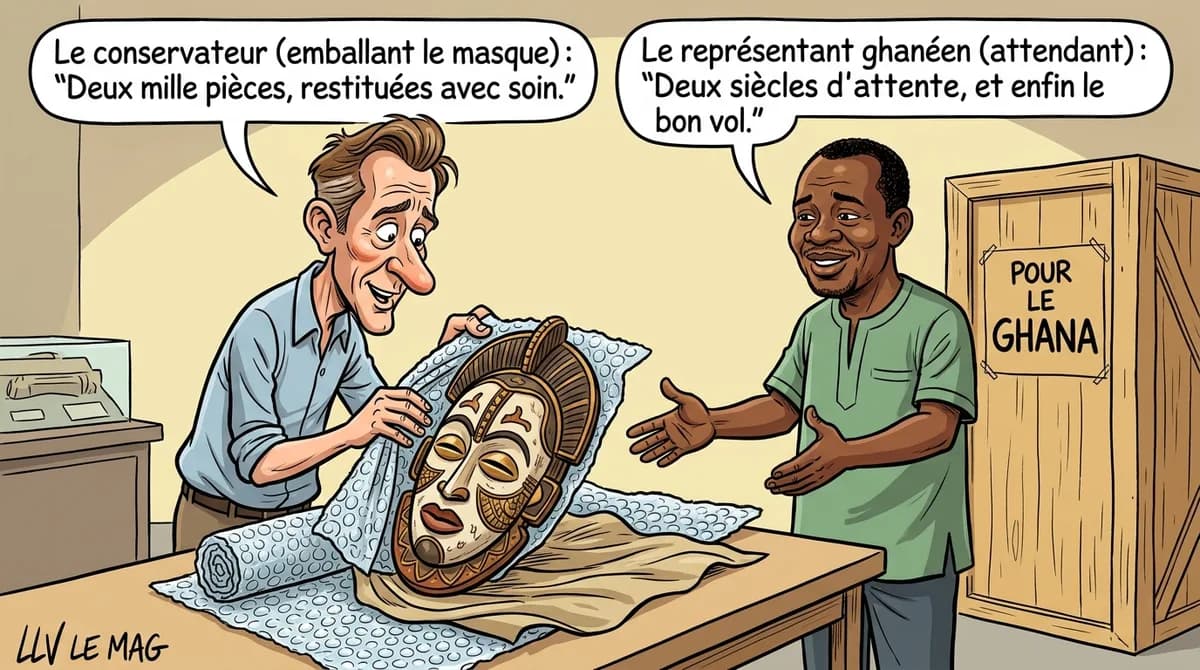
On 23 June 2026, Accra resonated with an announcement that goes beyond Ghana's borders: Germany and the Netherlands have pledged to return nearly two thousand cultural objects looted during the colonial era, a decision taken as part of the Restorative Justice Conference held from 17 to 19 June.
The conference, which brought together diplomats, scholars and civil‑society representatives, provided a platform for historic restitution claims. Ghanaian authorities presented, without revealing the exact contents, a catalogue listing the items that will be sent back to the country, a document handed directly to the head of state, John Dramani Mahama.
Ghana’s foreign minister, Samuel Okudzeto Ablakwa, shared the announcement on social media, emphasizing that each object, although not publicly identified, holds great cultural and historical significance for Ghana. He reminded that these goods, taken more than a century ago, are now living witnesses to a fragmented collective memory.
For Cameroonians and French‑speaking Africans, the impact of this restitution goes beyond the mere return of artefacts. It highlights the need to re‑examine European collections that, from museums in Berlin to those in Amsterdam, conceal items originating from the continent. The German and Dutch gesture opens the door to a regional debate on how African institutions can recover and reintegrate their heritage.
In a context where Cameroonian museums struggle to secure funding for conservation, the prospect of accessing authentic objects could revitalise local exhibitions, strengthen heritage education and boost cultural tourism. Restored heritage also means a reinforced identity, a tangible reminder of roots that future generations can touch.
This initiative could also serve as a catalyst for other African states that have long awaited concrete responses from their former colonial powers. Ghana is leading the way: by articulating its claims at an international forum, it creates a diplomatic precedent that Cameroon, Nigeria or Senegal could replicate to obtain their own restitutions.
The future therefore looks both hopeful and challenging. Ghanaian authorities will now have to define the logistics of transport, conservation and display of the objects, ensuring that restitution does not remain a symbolic act but becomes a genuine act of repair. For Africa, each returned piece represents a step toward reconciliation with its past and the building of a future where heritage is no longer loot but a common good.