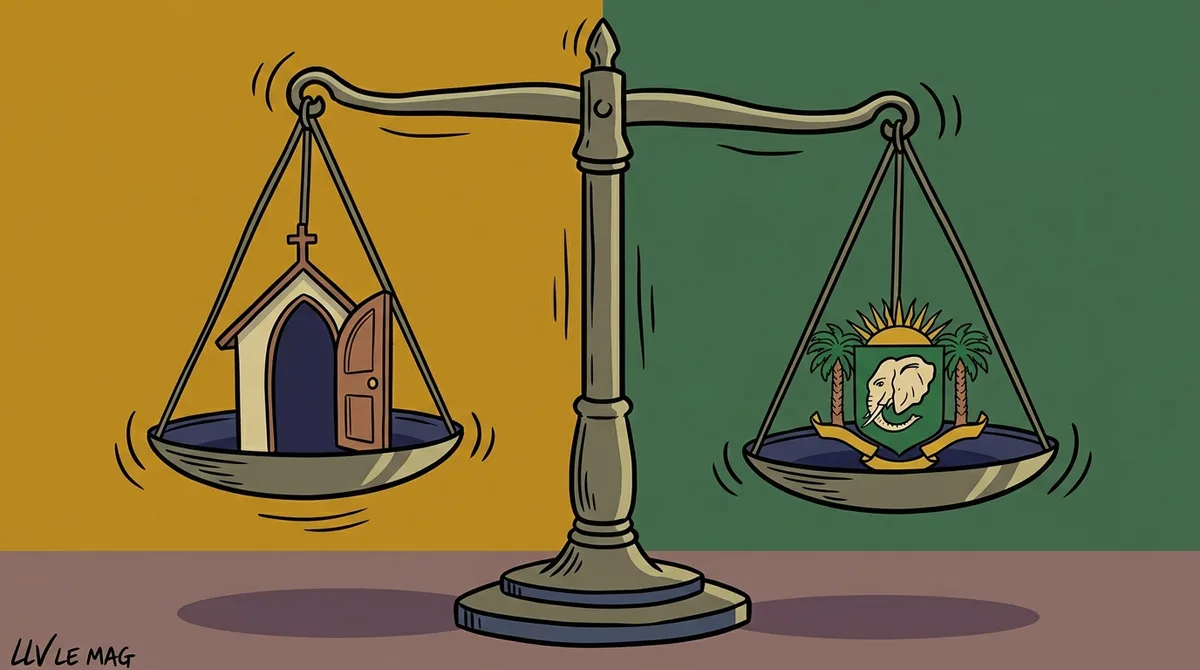
On July 12, 2026, Yaoundé was shaken by a new wave of shock: the government plans to close 1,400 revival churches, deemed illegal, after the tragic death of an 11‑year‑old girl at the end of June, whose alleged killer was presented as a member of one of those congregations. The announcement, relayed by Reuters and RFI Afrique, revives the thorny debate between freedom of worship and compliance with the law.
In the Étoudi neighbourhood, in the Nouveau Quartier, the night did not silence the songs nor the hand‑clapping that precede a service scheduled for the next day. “We just go to church, we don’t try to find out…,” says a congregant, illustrating the simplicity of religious practice that, for many, transcends administrative formalities. The scene shows that for believers, faith is a daily anchor, even in spaces often labelled “marshy” by authorities.
The minister of territorial administration, without naming specific leaders, justified the measure as necessary to protect minors and ensure compliance with the legal framework. Revival churches, often unregistered, are seen as vulnerable structures where state oversight is difficult. The girl’s tragedy thus served as a catalyst for a regularisation policy that, authorities say, aims to prevent any recurrence.
For the leaders of these communities, the announced closures are perceived as persecution. Some denounce a stigmatization of their beliefs, recalling historic persecutions suffered by religious minorities. Others, more pragmatic, view the crisis as an opportunity to affiliate with recognised churches in order to secure their activities and protect their followers. This duality reflects the tension between spiritual identity and legal conformity.
The concrete consequences for worshippers are multiple. On one hand, the shutdown of worship sites could disperse communities, erode social‑support networks and disrupt charitable activities often organised by these churches. On the other hand, increased regularisation could enhance financial transparency and give authorities better oversight of practices, thereby reducing the risk of abuse.
In Cameroon, where religion occupies a central place in daily life, the legality of revival churches touches both social cohesion and governance. Observers note that if the measure is applied with rigor and dialogue, it could create a safer framework for children. Conversely, a repressive approach could fuel resentment and push practitioners toward underground cults, worsening the problem it seeks to solve.
As the country awaits the first concrete decisions, the debate remains open. Authorities will have to balance child protection with respect for religious freedoms, while revival communities must choose between adaptation and resistance. The future of these 1,400 churches will depend on both sides’ ability to dialogue, clarify legal requirements and ensure that faith does not become a pretext for marginalisation.