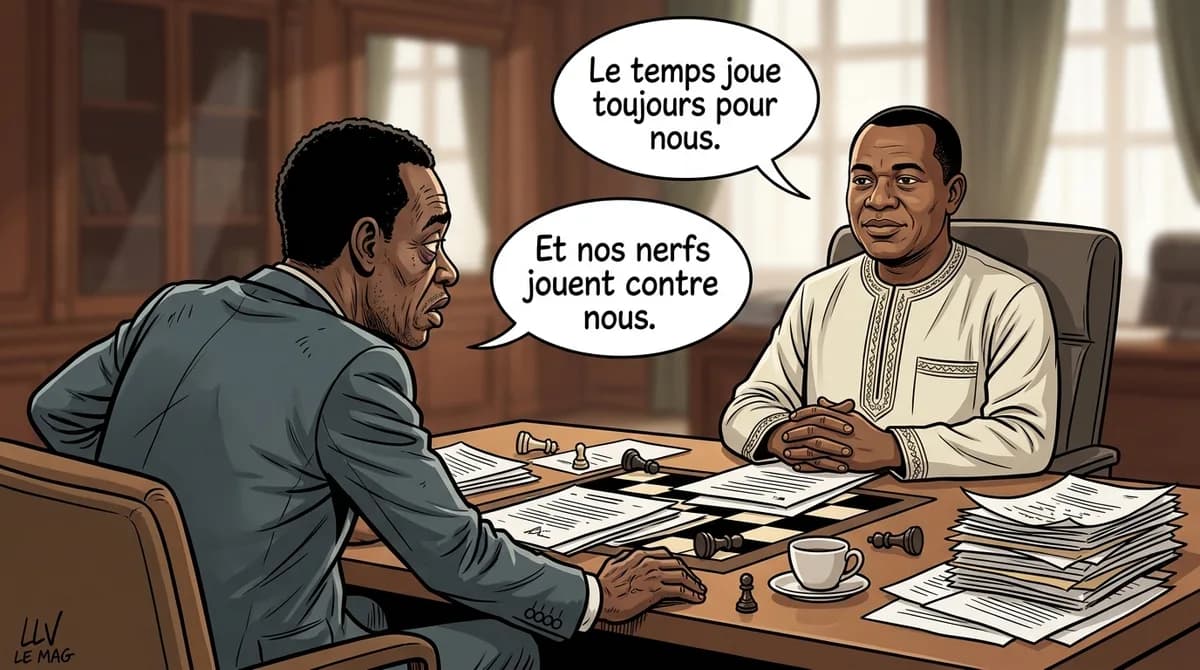
On June 30, 2026, Cameroonian media carried a chilling analysis: the government has turned psychological manipulation into a tool of domination. Under the label 'war of nerves', it is an invisible war of attrition, where bullets are replaced by rumors, fictitious lists and a permanent climate of uncertainty. Sun Tzu summed up the idea in his age‑old words: 'The supreme art of war is to subdue the enemy without fighting.'
The concept rests on an unlikely alliance between military strategy – invoking Sun Tzu, Linebarger and Lacheroy – and the mass sciences, notably the works of Serge Tchakhotine and Jacques Ellul. Political analyst Louis Marie Kakdeu notes that the theory hinges on a combination of conditioning, fear and media harassment to generate a collective psychological assault. The result is no longer a simple propaganda campaign, but a structured system designed to weaken collective will.
What sets the Cameroonian case apart is that the opponent is not an external enemy but the entire internal apparatus: civil servants, elites and the population. The regime turns the machinery of the state into weapons of disorientation, making every administrative reshuffle an opportunity to sow doubt. Thus, a 'ministerial reshuffle' is no longer just a reallocation of posts; it becomes a mechanism that erodes the serenity of officials, who are kept in a state of anxious waiting.
Among the most striking illustrations is the wear‑and‑tear caused by waiting. Government lists, often fabricated and spread on social media, circulate rapidly, feeding a climate of anticipatory post‑traumatic stress. Officials confronted with phantom appointments see their projects stalled, promotions uncertain, and teams demoralised. This confusion strategy creates mental fatigue that spreads to public services, slowing decision‑making and policy implementation.
The consequences for civil servants are tangible: burnout, loss of confidence in superiors, and gradual disengagement. The climate of mistrust reverberates in the quality of services offered to citizens, who perceive the state as an unpredictable actor. Professional insecurity drives some to leave the public sector, worsening skill shortages and feeding a vicious circle of inefficiency.
At the societal level, the war of nerves erodes trust in institutions. The media, sometimes complicit, disseminate contradictory information that fuels popular scepticism. Communities already weakened by economic and health crises see their anchors crumble, fostering cynicism and civic disengagement. The phenomenon thus becomes a real obstacle to development, as social cooperation dissolves under the weight of widespread mistrust.
The future will depend on the country's ability to break this cycle of mental exhaustion. Transparency measures – official publication of appointments, independent oversight of government communications – could shrink the space for manipulation. At the same time, psychological resilience programmes for public agents, coupled with a reform of crisis management, would provide a structured response. Without such a turn, governance will remain trapped in a strategy that sacrifices collective well‑being on the altar of power.