
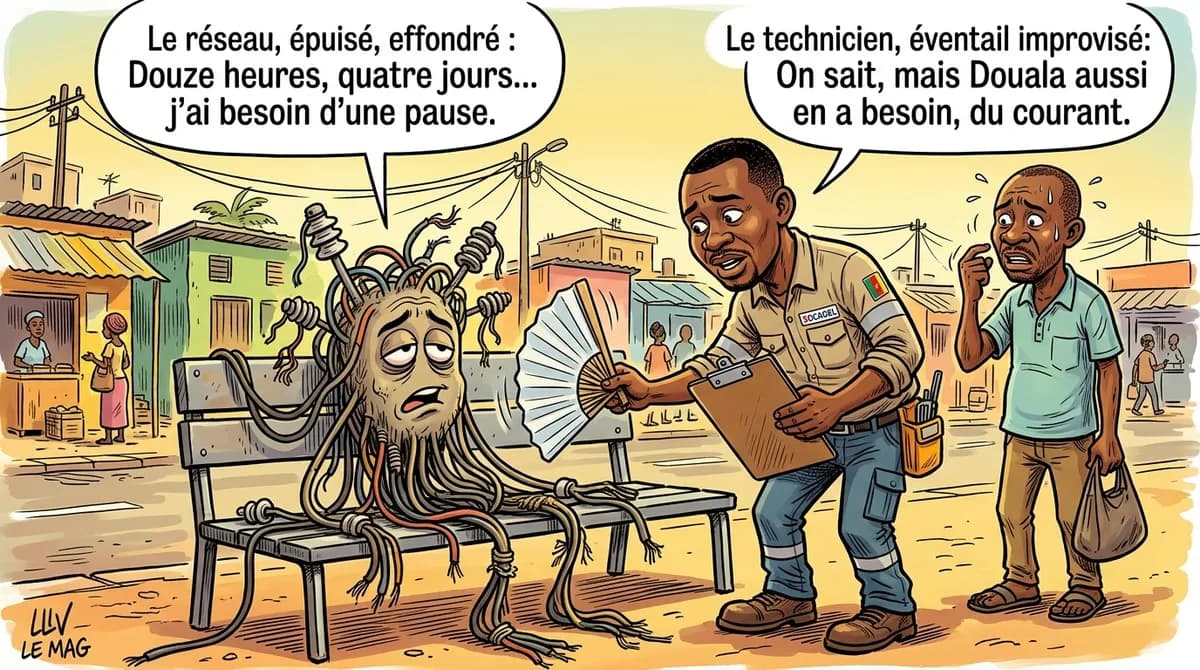
Twelve hours in the dark, four consecutive days. That's the program Socadel has set for tens of thousands of Doualans from Wednesday, July 1, to Saturday, July 4, 2026. A routine, almost. Yet a routine that weighs heavily in a city where factories, shops and households run to the rhythm of the meter.
The electricity distributor states plainly that these interruptions stem from maintenance work on its network, affecting several sectors of the economic capital. Each affected day runs from 6 a.m. to 6 p.m., a broad window that covers most of the productive and commercial activity.
The schedule leaves no room for doubt. On Wednesday, ITBA, Non Glace, Newtown, Shell Village and Bilongue will be plunged into darkness. Thursday, July 2, the list expands considerably: Usine Pasta, Bepele, Isembeck, Authentica, Ndobo, Bonendale, Kotto, Logbessou, UTI, Akwa Nord, Istama and even the Ad‑Lucem Sable Hospital are among the zones hit. Friday, July 3, the cuts affect Hibiscus, the CEAC, Lycée Joss, Bonanjo, Logpom Bassong, the PK8‑to‑PK14 axis, Pindo, the Military Engineering site, Mbengue City and Ndoghem. On Saturday, July 4, the outages are concentrated on Hibiscus and the CEAC.
Is this not a sign of a strained grid? These drip‑feed announcements are not an isolated accident. They occur within a tense electrical context that the metropolis lives through. A few days before this new schedule, the city had already endured a brutal episode. Since Sunday, June 28, 2026, thousands of Doualans have been living with power cuts, factories halted, shops in the dark and families without electricity.
The distributor then had to fight back. On Monday, June 29, 2026, Socadel issued an official communiqué that painted a largely positive picture: 96 % of the city was back on electricity, and 80 % of the zones affected on Sunday had been re‑energized. A reassuring balance on paper, but one that left pockets of resistance and, above all, a deeper malaise.
Behind these recurring incidents lies a node, both literally and figuratively. Beyond local faults, Socadel points to a major structural problem: the critical congestion at the Bekoko transmission node, a nerve centre that aggregates and redistributes a large share of the Littoral region's power and suffers from saturation that limits transit capacity and delays the full revival of the system. In other words, as long as this bottleneck remains, patchwork fixes will continue.
It helps to recall where this operator comes from to grasp the scale of the challenge. Socadel, the new Cameroonian Electricity Company, was created in May 2026 to succeed Eneo. A presidential decree signed by Paul Biya formalised the transformation, with a capital of 43.9 billion CFA francs, headquarters in Douala and the state as the sole 100 % shareholder. A return of public power to a strategic sector, hailed as a symbolic turning point.
But the legacy is heavy. This crisis arrives in a particular context: a public enterprise created in May 2026, Socadel inherited an ageing network and a monthly financial deficit estimated at 13 billion CFA francs. Experts stress a point often overlooked: the problem of Cameroon's electricity sector lies less in distribution than in generation and transmission.
For the resident of Bonanjo as for the merchant in Akwa Nord, the question remains down‑to‑earth: how many more outage schedules before the lights stop flickering? These four days of programmed load shedding will, on their own scale, indicate whether the young public company can turn modernization promises into continuous current. The coming weeks, and the state of the Bekoko node, will provide an initial answer.