
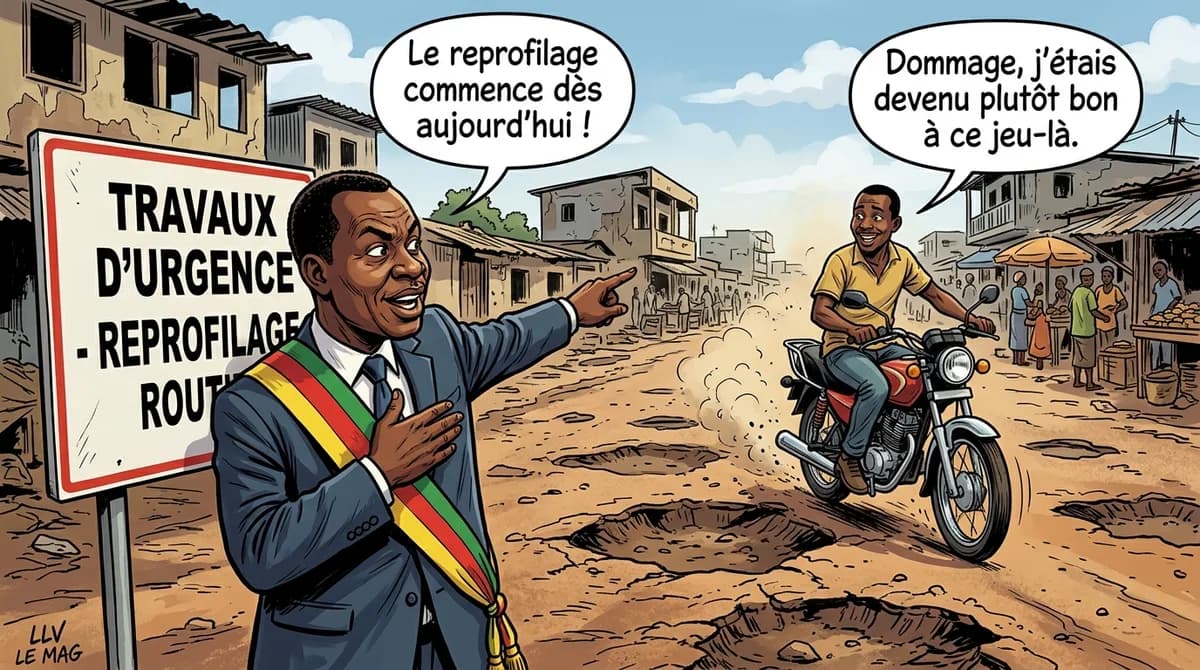
In Cameroon's economic capital, a constant stream of cars and two‑wheelers travels each day up the Tunnel Ndokoti slope, a key artery linking the city centre with outlying districts. This morning, Douala mayor Roger Mbassa Ndine ordered a complete resurfacing of the road, a decision that reflects the Urban Community's stated intent to address on‑the‑ground emergencies.
The city's technical services reported advanced deterioration of the pavement, marked by deep cracks, potholes and a loss of levelness that slow traffic and raise accident risks. “We observed a degradation that could no longer be ignored,” the mayor explained, emphasizing that motorists' and pedestrians' safety was at stake.
Work therefore began immediately on the tunnel ascent, where teams from the Douala Urban Community deployed grading and compacting machines. The goal is to restore a smooth, uniform surface capable of handling the daily traffic volume, estimated at several tens of thousands of vehicles. This emergency intervention aims to reduce the bottlenecks that cripple commuters during peak hours.
For local residents, the resurfacing means more than a construction site: it promises a considerable time saving, lower fuel costs and an improved quality of life. By easing traffic, local merchants will receive their goods more quickly, while workers will gain punctuality. The project also fits into the fight against pollution, as frequent vehicle stops contribute to higher CO₂ emissions.
The initiative adds to the multiple urban mobility programmes launched in recent years, including bus network modernisation and the creation of dedicated lanes for public transport. Despite these efforts, Douala still faces major challenges: an ageing road network, rapid urbanisation and limited financial resources. The resurfacing of the Tunnel Ndokoti ascent shows that authorities are ready to mobilise the necessary means whenever a critical situation arises.
Mayor Roger Mbassa Ndine reminded that the operation was “a concrete response to relieve the population.” He also reaffirmed the Urban Community's commitment to better urban mobility, promising continuous monitoring of road conditions and proactive planning of future works. This pledge follows a preventive rather than reactive logic, aiming to prevent other sections from suffering the same fate.
As the machines finish grading and the roadway resumes its role as a vital corridor, Douala's inhabitants await the first results. If the resurfacing delivers smoother traffic, it could become a model for a targeted, reactive approach across Cameroon’s road network. The challenge remains to sustain these improvements over the long term, by combining financing, technical expertise and political will.