
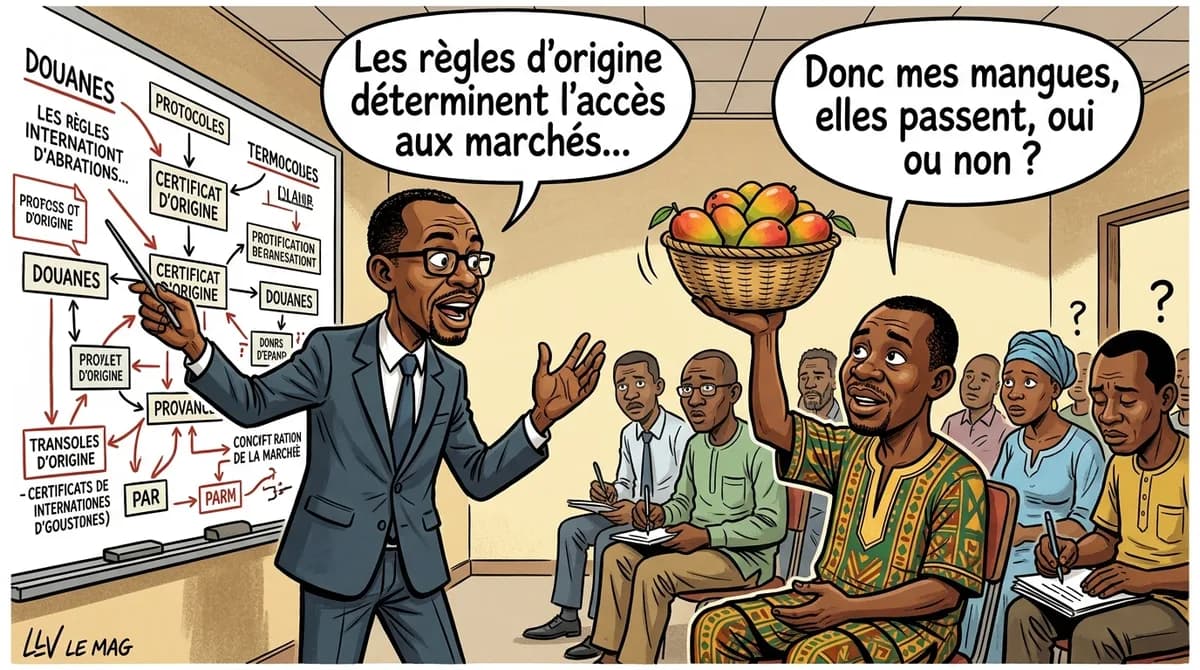
From June 29 to July 2, 2026, the port city of Douala hosted an intensive workshop on rules of origin, a cornerstone of foreign trade. Organized by the National Shippers Council of Cameroon (CNCC), the event forms part of the country's effort to strengthen commercial capacities at a time when multilateral and bilateral agreements are reshaping market‑access conditions.
Under the auspices of the CNCC, national and international experts gathered to train sector players—shippers, freight forwarders, logistics operators—on the technical and legal requirements of rules of origin. Support from the European Union and the World Trade Organization enriched the programme with practical sessions, panel discussions and experience sharing from diverse regions.
Rules of origin determine the country in which a product is deemed to be made, a prerequisite for benefiting from the tariff preferences provided by trade agreements. Without reliable certification, Cameroonian exporters risk losing duty reductions or being excluded from global supply chains. Mastering these criteria therefore becomes a strategic lever to optimise margins and secure market outlets.
For Cameroon, whose main exports include cocoa, coffee, timber and manufactured goods, compliance with rules of origin opens doors to the European Union, Canada and the United States, where preferential tariffs can reach 0 % under preference agreements. Beyond the tariff gain, origin recognition boosts the visibility of the “Made in Cameroon” brand and strengthens foreign partners’ confidence.
However, several obstacles remain. The required documentation is often cumbersome, traceability systems are underdeveloped, and staff training is sometimes insufficient. Small and medium‑sized enterprises, which form the core of Cameroon’s economy, struggle to mobilise the resources needed to implement certification procedures that meet international standards.
In this context, the CNCC, backed by the European Union, has set up a post‑workshop support scheme, including follow‑up sessions, digital tools for tracking flows, and a network of experts available to advise companies. This collaborative approach aims to turn a one‑off training into a lasting change in practice.
The expected outcomes of this expertise boost are multiple: improved export competitiveness, market diversification, creation of skilled jobs and, in the longer term, contribution to a positive trade balance. As global trade negotiations continue to evolve, Cameroon’s ability to master rules of origin proves to be a decisive asset for its regional and international economic integration.