
A sealed envelope, two impeccably forged decrees, and a nation that, for an afternoon, almost tipped over. That sums up the scandal that has shaken Cameroon since mid‑June 2026. On Tuesday, June 30, the State finally broke its deafening silence. Yet the statement meant to close the controversy may well open another.
Let's pick up the thread. According to several Cameroonian outlets, the incident dates back to June 12, 2026. A man arrived at the headquarters of the national broadcaster in Yaoundé, confident and unusually insistent. He claimed to possess a document of the utmost importance, allegedly from the Etoudi palace, with a clear instruction: the text must be read on the 5 p.m. news broadcast.
Inside the sealed envelope were two texts. One decree appointing a vice‑president of the Republic, the other announcing the formation of a new government. Visually, the forgery was flawless: the document bore all the hallmarks of authenticity, the official presidential seals and a signature attributed to the head of state. On paper, nothing distinguished the fake from a genuine presidential act.
It was one man's instinct that changed everything. In the absence of Director‑General Charles Ndongo, journalist Aimé Robert Bihina’s vigilance prevented the broadcast. Verification required a phone call all the way to Geneva, where President Paul Biya was staying on a private trip since June 7. The presidential entourage formally denied any signature. No digital protocol, no security code—just an experienced staffer, his knowledge of official channels, and a crucial doubt.
What would have happened if the text had gone on air? Had the decree been read at 5 p.m. on the national radio, Cameroon would have been left with a fictitious government, a self‑proclaimed vice‑president, and total confusion at the top of the State. In a country where CRTV represents, in the collective imagination, the very voice of the State, such a denial would have arrived long after the fire had started.
To grasp the significance of the maneuver, one must consider the context. The vice‑president post, reintroduced by the April 2026 constitutional amendment, is intended as the automatic succession line to the top of the State. In other words, appointing someone to that seat, even fraudulently, would amount to crowning a presumed heir. In a country where 93‑year‑old Paul Biya has not reshuffled his cabinet since 2019 and where succession questions have fueled speculation for years, the emergence of a fake decree naming an unknown individual to that role could have sparked a major institutional crisis.
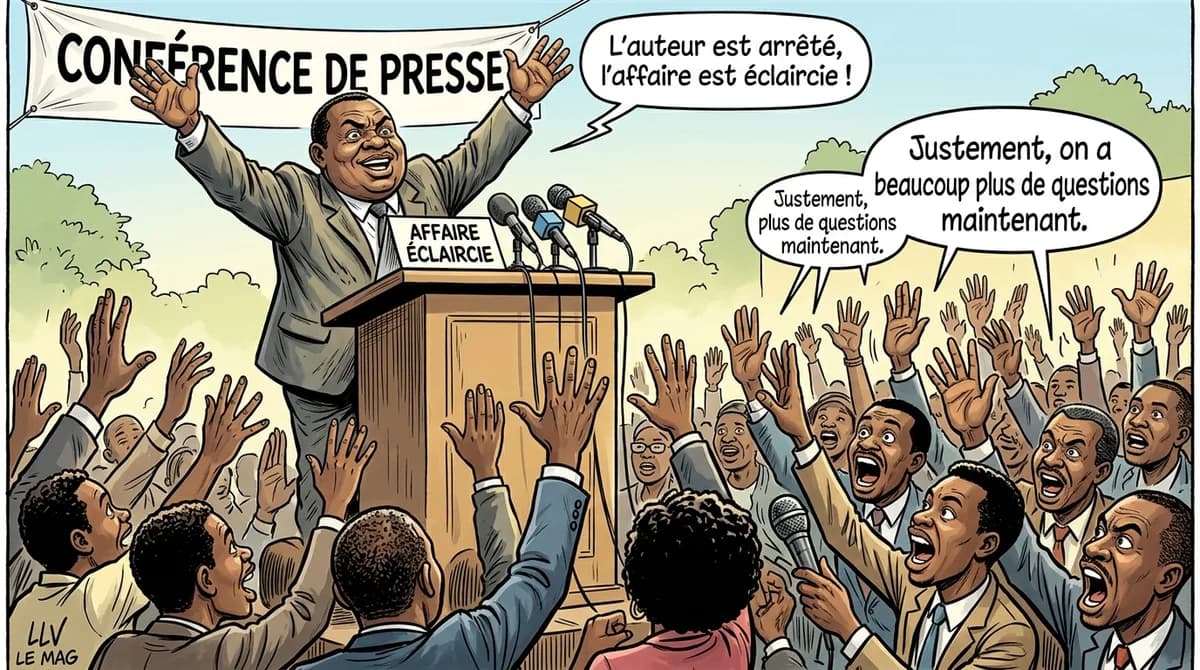
The official communiqué finally provided a framing. According to the statement signed by René Emmanuel Sadi, Minister of Communication, an individual presented himself in June at the CRTV premises in Yaoundé and deposited a sealed envelope containing a document that, on its face, bore the official presidential seals and a signature attributed to the head of state. The government asserts that the document was never duly signed, that its author is in custody, and that the appointment of a vice‑president remains the sole prerogative of the head of state.
But where the State seeks to calm matters, public opinion asks questions. Who is the man at the centre of the case? According to several outlets, he is Johann Adriel Sitchom Kuate, sometimes listed in reverse order as “Sitchom Johann” by sources. One version, relayed by a whistle‑blower, portrays him as a lone actor driven by a divine revelation. A darker reading sees a botched operation later cloaked in mystical delusion to obscure the trail. Two theories, no public evidence to resolve the mystery so far.
Beyond the sensational incident, the episode reveals a glaring vulnerability. How can an act with such far‑reaching consequences ultimately hinge on the instincts of a single journalist and a phone call abroad? Disinformation has crossed a new threshold: from fake PDFs on WhatsApp to physical infiltration of institutions. Judicial developments are awaited, and with them the hope of answering the question that now haunts all of Cameroon: who, exactly, stood to benefit from this move?