
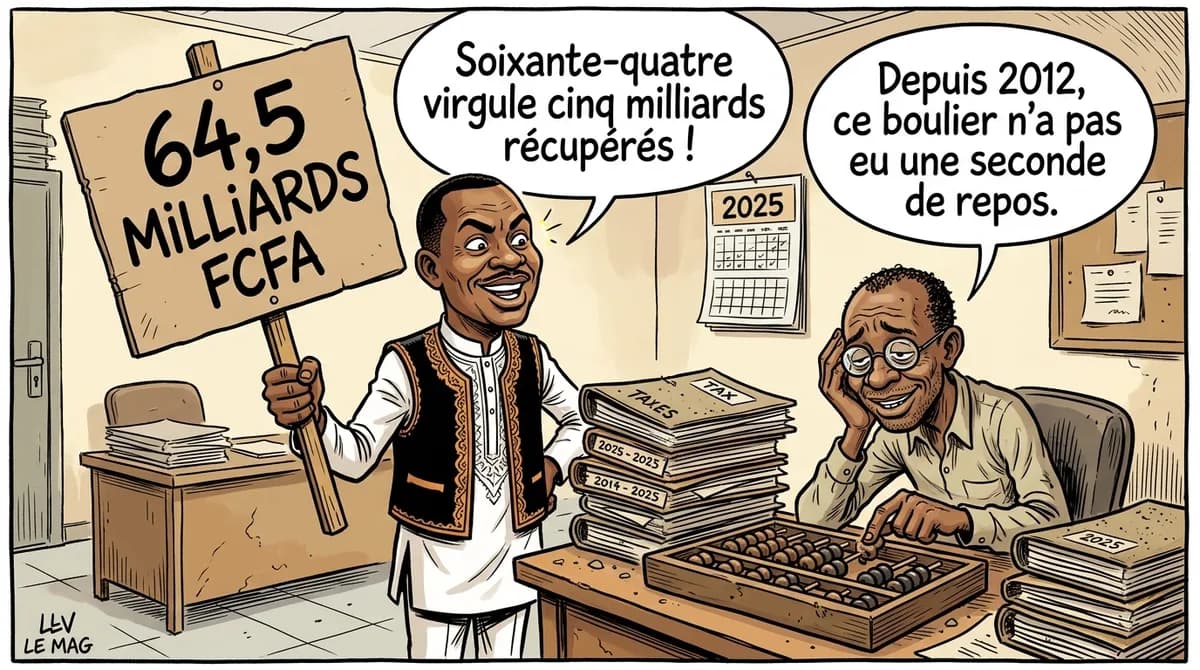
On July 3, 2026, Cameroon’s tax authorities announced a new milestone: more than 64 billion CFA francs recovered by cracking down on fraud and evasion. The figure, which exceeds expectations, underscores the country’s determination to protect the public treasury and restore taxpayers’ confidence.
During the 2024‑2025 period, 279 information requests uncovered €20.9 million – equivalent to 13.68 billion CFA francs in additional revenue. Each request stemmed from a targeted investigation, exposing companies and individuals who had hidden income from the tax authorities. These one‑off gains demonstrate the effectiveness of a proactive approach, where every case becomes a piece of the national fiscal puzzle.
Beyond these recent results, the 2026 African Tax Transparency Report notes that between 2012 and 2025, Cameroon collected €98.4 million – roughly 64.45 billion CFA francs – through the exchange of information among tax administrations. This cross‑border mechanism, backed by multilateral agreements, uncovered hidden financial flows and reintegrated sums that would otherwise have fed the underground economy.
The leadership of the General Directorate of Taxes, praised in the same report, proved decisive. The reforms underway – notably the planned automatic exchange of financial account information slated for September 2026 – boost the tax authority’s ability to act in real time. This automation promises to cut detection delays and accelerate the collection of owed taxes.
Despite these advances, tax fraud persists, with annual losses estimated at several tens of billions of CFA francs. The reality is prompting the government to rethink the traditional filing model, deemed too slow and vulnerable to manipulation. The need for a paradigm shift thus becomes a matter of economic sovereignty.
The 2026 Finance Bill introduces a ‘real‑time taxation regime’, outlined in the new Article L.8 sexies of the General Tax Code. According to a circular from Finance Minister Louis Paul Motaze dated December 31, 2025, the scheme ‘ensures continuous collection, enhances operational transparency and significantly reduces the risk of fraud or concealment, while safeguarding tax revenue performance.’ In practice, filings will be updated continuously, narrowing the gap between actual turnover and reported figures.
For taxpayers, the measure demands tighter accounting discipline, but also promises a fairer tax burden where fraudsters no longer enjoy a competitive edge. For the state, the potential gain translates into a stronger budget base capable of financing public infrastructure and social programmes. If implementation proves successful, Cameroon could turn a chronic loss into a sustainable revenue stream, cementing its role as an economic engine in Central Africa.