
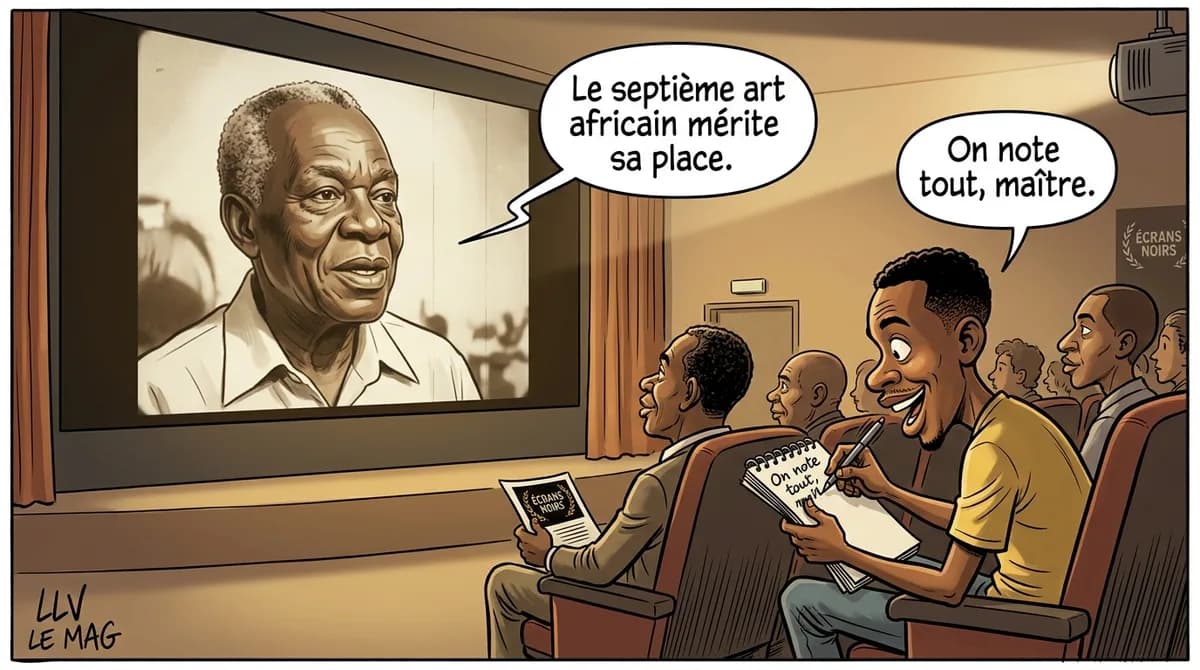
In Yaoundé, on June 24, 2026, the esplanade of the National Museum became a stage for collective emotion. Artists, filmmakers and emerging talents marched under the Cameroonian flag to salute the memory of Bassek Ba Kobhio, an iconic figure of Cameroonian culture, whose death on May 12, 2026 left a void across the continent.
Born on January 1, 1957 in Nindjé, Bassek Ba Kobhio first studied sociology and philosophy before turning to the seventh art. His career began as an assistant director, notably alongside Claire Denis on the 1987 film "Chocolat", an experience that shaped his cinematic vision and his commitment to telling Africa with authenticity.
The director quickly established his style. His first feature, "Sango Malo" (1991), adapted from his own novel, won the Audience Award at the African Film Festival in Milan. He followed with "The Great White of Lambaréné" (1995), a landmark work that cemented his reputation. Yet it was the creation of the Écrans Noirs festival that sealed his legacy: each year, the Douala gathering becomes a beacon for African cinema, providing visibility to young filmmakers and local stories.
The June 24 ceremony blended testimonies, traditional songs and artistic performances. Officials from the Ministry of Culture, members of CRTV and former collaborators shared memories, while young directors presented short films inspired by the master’s oeuvre. Dances and poems punctuated the program, reminding that cinematic art is part of a broader cultural tradition.
For Cameroonian audiences, this tribute is not merely a reminder of the past but an invitation to continue the path forged by Ba Kobhio. By celebrating his journey, emerging filmmakers find validation of their ambitions, and cultural institutions are reminded of their role as guardians of audiovisual heritage. The Écrans Noirs festival, now ingrained in the collective consciousness, enjoys a renewed wave of public and private support, essential for its regional expansion.
Bassek Ba Kobhio’s death at 69 in Yaoundé sparked a wave of mourning, but also of pride. His work, rooted in Cameroon’s sociological reality yet reaching an international audience, opened doors for African filmmakers who previously struggled to be heard. His dedication to training new generations left a network of apprentices, mentors and institutions that keep his creative spirit alive.
As Cameroon prepares to host the next edition of Écrans Noirs, organizers promise to broaden the training programme and include more community projects. The memory of Bassek Ba Kobhio will serve as a compass, guiding cultural policies toward greater recognition of cinema as a vehicle for identity and development. The country, and indeed the continent, must keep alive the flame he ignited.