
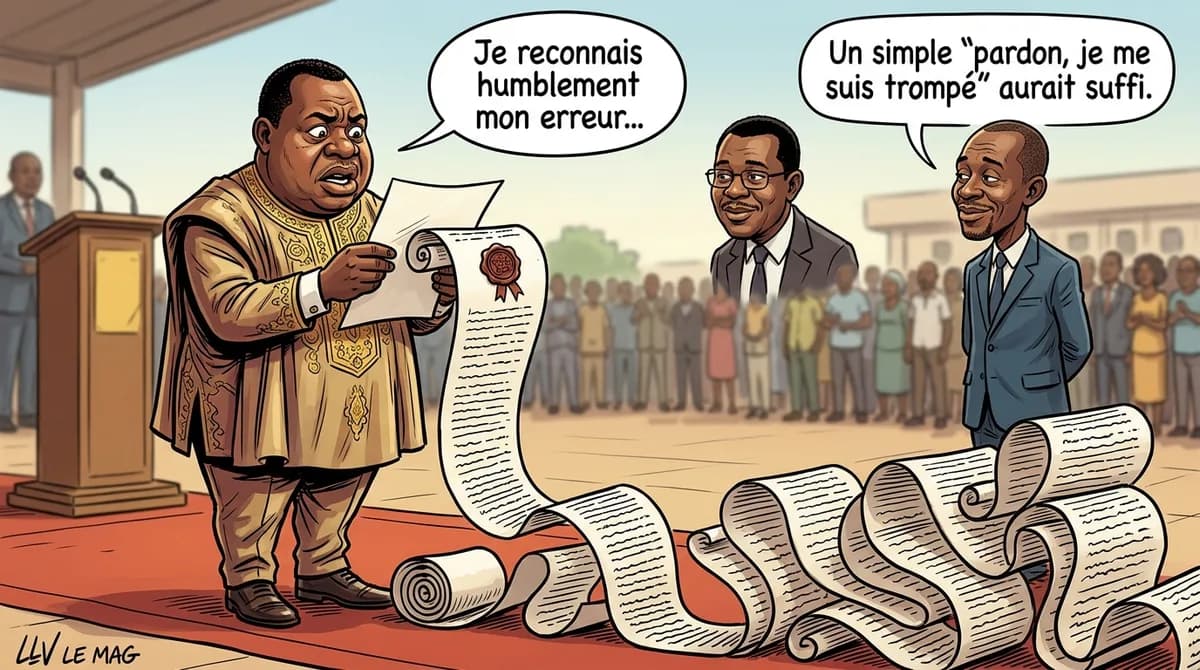
On July 4, 2026, Douala’s political arena was thrust into the spotlight, not by a protest or an election, but by an unusual public statement: Deputy Mayor of the 5th commune, Joseph Espoir Biyong, published an open letter in which he fully assumed responsibility for a media gaffe and paid tribute to an opponent he had previously criticised.
In the letter, Biyong addresses Mamadou Mota, vice‑president of the Cameroon Reform Movement (MRC), stating: “I offer you my apologies,” before explaining that, during a live broadcast on his Facebook page, he had ascribed to Mota remarks that “never existed.” The author does not stop at a simple apology; he acknowledges his humanity, admitting, “I am only a man, therefore prone to error.”
The incident occurred during a live stream in which Biyong, without fact‑checking, circulated fabricated quotes targeting Mota. The deputy mayor, known for his activism within the Socialist Front of New Cameroon (FSNC), thereby sparked a controversy that quickly gained traction on social media. By acknowledging his mistake, he aims to repair the damage to his counterpart’s reputation and to restore public confidence in their dialogue.
At the heart of the letter, Biyong lauds Mota’s act of courage on October 10, 2025, when he urged Cameroonians to back Issa Tchiroma Bakary in the presidential election of October 12, 2025. According to the text, that appeal helped prevent the fragmentation of votes among twelve candidates, consolidating popular support behind a single contender. This public acknowledgment underscores Biyong’s emphasis on civic responsibility and a leader’s ability to “step aside so another may shine.”
The impact of this statement goes beyond a mere apology. For the FSNC, which positions itself as a reformist party, Biyong’s approach can be seen as a gesture of political maturity, opening the door to more constructive dialogue with the MRC. For the MRC, Mota’s as‑yet‑unpublished response will be scrutinised as a barometer of the party’s willingness to embrace reconciliation while maintaining its oppositional stance. In a political landscape where partisan rivalries are often heightened, such public exchanges could defuse tensions and encourage other actors to favour correction over confrontation.
For residents of Douala‑5 and, more broadly, the Cameroonian diaspora, the episode serves as a reminder that public speech is subject to truth‑checking. The lesson is clear: local officials, even those in close‑contact roles, must verify their statements before broadcasting them. Biyong’s open apology could bolster the credibility of municipal institutions and prompt the media to exercise greater vigilance toward unsourced claims.
Looking ahead, this interaction may inspire other leaders to adopt a more responsible posture on digital platforms. Should dialogue between the FSNC and the MRC continue, it could pave the way for local coalitions capable of tackling the economic and social challenges facing the Littoral region. Biyong’s mea culpa, far from being a mere act of contrition, stands as a potential milestone toward a more transparent and collaborative Cameroonian politics.