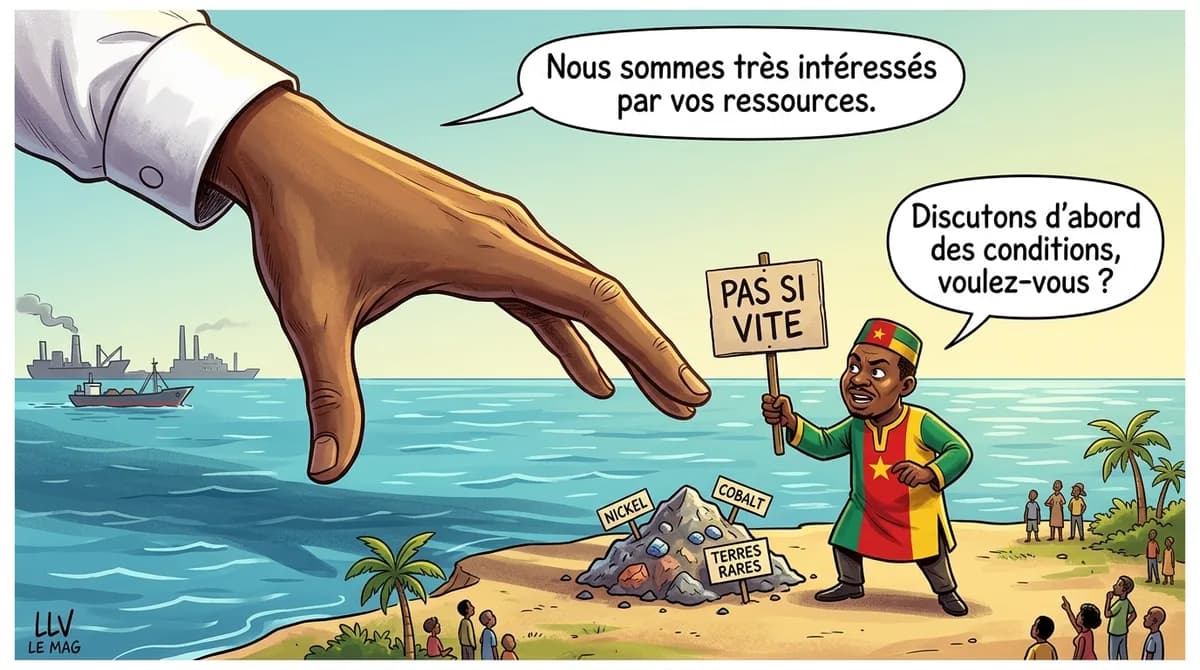
On June 26, 2026, Cameroonian media are questioning a new dynamic: the presence of a U.S. delegation in Yaoundé, organized by associates of Donald Trump, has revived the debate over the country's natural resource sovereignty.
Since his first term, the former U.S. president has reshaped American strategy to contain China, which he labels the number‑one adversary to U.S. hegemony. This shift has manifested in an explicit aim to reduce dependence on strategic materials supplied by Beijing, notably semiconductors, rare minerals and rare earths essential for advanced technologies.
In this context, technological dominance becomes the common thread of a policy that bets on securing supply chains. The United States seeks to replace Chinese imports with alternative sources, favoring countries that host deposits of nickel, cobalt and rare earths—two resources crucial for batteries and electronic equipment.
It is within this framework that GreenMet, a company founded by Drew Horn, has emerged as a key player. Horn, a former national security chief for Trump and senior adviser to the Director of National Intelligence, visited Yaoundé a few months ago. His low‑profile trip presented an American program backed by trusted presidential collaborators, including Georges Sorial, former legal adviser, and Keith Schiller, ex‑head of security for the Trump Organization.
During the visit, a delegation of senior U.S. officials signed a memorandum of understanding (MoU) with Cameroonian partners. The exact contents of the document have not been made public, but it is confirmed that American Renaissance Minerals (ARM), a subsidiary directly linked to GreenMet, now holds the lead position on the country's nickel and cobalt project. This move signals an intent to control the entire value chain, from extraction to commercialization.
For Cameroon, the stakes unfold on two fronts. On the one hand, access to capital and technological expertise could accelerate mine development, create jobs and boost state revenues. On the other hand, the concentration of foreign investment in entities close to Trump’s circle raises concerns about transparency, governance and environmental impact, especially in the southern regions where cobalt deposits are concentrated.
The future will depend on the Cameroonian government's ability to negotiate clear terms, ensure protection of local communities and align these projects with a national strategy of economic diversification. Observers will watch closely the implementation of the MoU, contract transparency and the responses of regional actors, which could redefine Cameroon’s role in the USA‑China technological rivalry.