
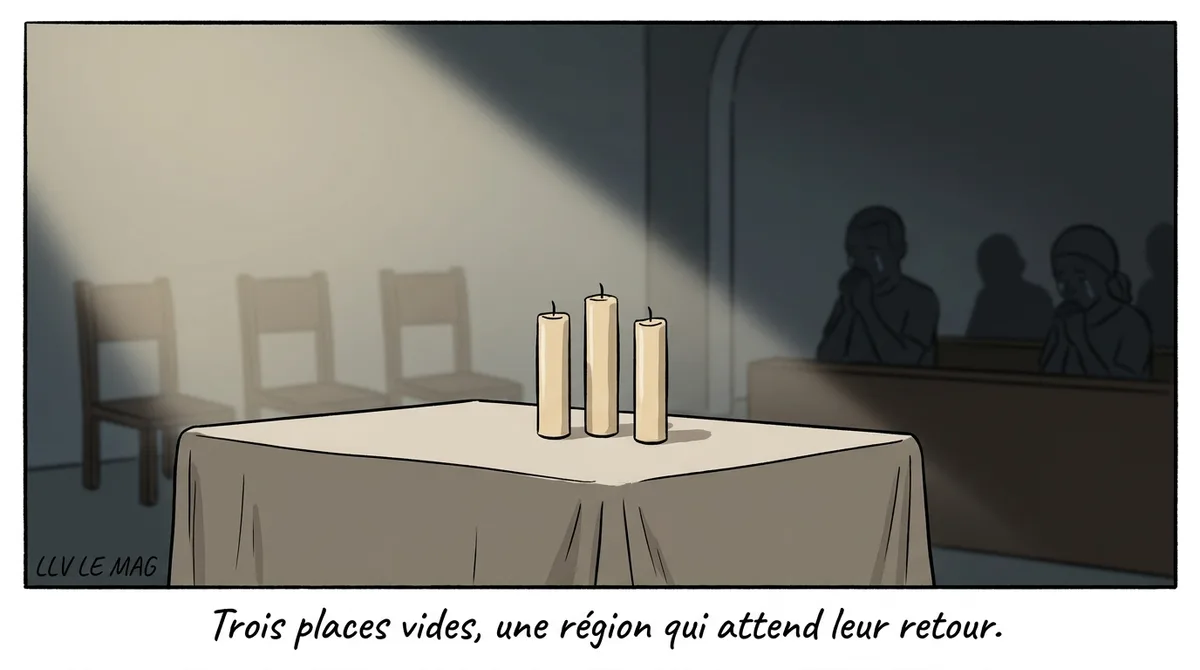
He had returned home to celebrate a moment of grace, only to find captivity. On the night of June 27, 2026, Father John Bosco Bihkong, a newly ordained priest, was snatched from his native village of Melim in the Ndop district, deep in the North‑West region. Two companions suffered the same fate. Thus, a first Mass—once a symbol of hope—turned into a trial for an entire community.
The facts are now clear. Father Bihkong, serving in the Diocese of Nkongsamba in the Moungo department of the Littoral region, had traveled to his hometown to celebrate his first Mass. He was accompanied by Brother Sylvester Sewong, caretaker of the Kékem convent, and Brother Marie Rodrigue Sop, who had just taken his perpetual vows. All three belong to the Emmanuel Franciscan Brothers congregation. They are now being held by unidentified abductors.
The alert came from the Church hierarchy itself. The information was issued by the Bishop of Nkongsamba, Msgr. Dieudonné Espoir Atangana, and relayed in a communiqué signed by the Vicar General, Msgr. Joseph Tchinda Dountio. The message, addressed to diocesan Catholic leaders, the faithful and well‑meaning individuals, urges prayer and mobilization for the release of the three servants of God. It is a call that reflects both faith and concern.
Why does this tragedy resonate so deeply? Because it is not an isolated incident. Once again, the clergy is paying a heavy price in an Anglophone crisis that has persisted for a decade. Priests, pastors and religious figures are regularly among the targets of armed groups in the North‑West and South‑West regions. The clerical habit, once thought to confer moral protection, no longer shields them from violence.
Collective memory indeed holds painful precedents. In September 2022, five priests and a nun were abducted in Nchang, South‑West region, and released weeks later, with the terms of their freedom never disclosed. More recently, in November 2025, the Archbishop of Bamenda, Msgr. Andrew Nkea, announced the detention of six priests and a layperson. After five were freed, the kidnappers kept Father John Berinyuy Tatah and demanded a ransom.
That same Father Berinyuy Tatah, kidnapped in the Ndop district, was eventually released. The Vatican later appointed him auxiliary bishop of the Archdiocese of Bamenda, a recognition that does not erase the wound. That the new abduction occurs in the same Ndop district is no coincidence: it underscores the persistence of entrenched pockets of insecurity, where state authority struggles to assert itself against separatist fighters.
For believers in the North‑West, the message is chilling. How can they celebrate, gather, and pass on the faith when the officiants themselves become prey? Each kidnapping further weakens the spiritual and social fabric of an already drained region. It forces parishes to close, priests to flee, and communities to live in fear. Behind the kidnapping statistics lies a slow suffocation of local religious life.
At the time of writing, no public demand or condition has been disclosed concerning the three religious men. Developments are awaited, and caution is warranted regarding the exact fate of the captives. One certainty remains: as long as the Anglophone crisis lacks a durable political solution, the Church will continue to count its martyrs and hostages. The release of Father Bihkong and his brothers would be a relief, but it will not resolve the underlying issue.