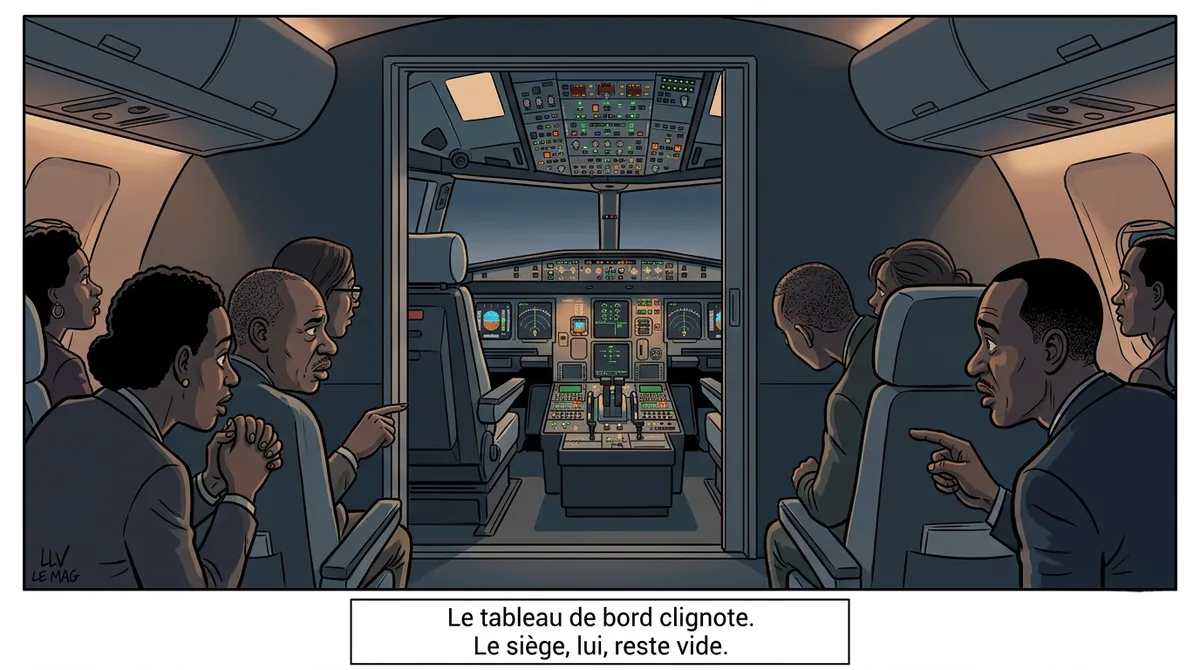
On June 28, 2026, Sam Séverin Ango, a figure of the Cameroon People's Democratic Movement, voiced a question that goes beyond mere aeronautical jargon: "Who is the pilot of the Cameroon plane right now?" The remark, made live on the set of "Grand Débat", immediately captured the attention of an audience hungry for guidance during a period when President Paul Biya is on a private stay in Europe.
The head of state's absence at the helm of the country creates a symbolic void. For many Cameroonians, the president is the steering wheel that keeps the nation aloft. His departure from national territory, even for a private trip, fuels the feeling that the helm is left adrift, hence the metaphor of a pilot‑less plane. This perception is accompanied by a concrete worry: who ensures continuity of strategic decisions? Who watches that economic and security trajectories do not deviate?
The term "pilot" carries a double meaning here. On one hand it denotes the head of state; on the other it symbolizes the whole cadre of officials, from the presidency to ministries, who orchestrate national policy. By raising the question of a co‑pilot, Ango seeks to reassure the population, showing that a rescue team is ready to intervene. The query thus becomes a barometer of citizen confidence: without visibility on the actors governing, insecurity grows.
At the same time, Ango denounced the broadcast of fake decrees on CRTV, a scandal that, in his words, "strongly shakes the pride of being Cameroonian." The media, supposed to be a mirror of truth, were accused of spreading unauthenticated documents, sowing doubt about the legitimacy of public decisions. Despite the massive circulation of these items, no official voice has confirmed the decrees' authenticity nor announced an investigation, contrary to what several media outlets suggested. This institutional silence reinforces the opacity that hangs over the political scene.
The lack of an official response creates an informational vacuum that citizens often fill with mistrust. In a context where confidence in institutions is already fragile, the absence of transparency fuels rumors and weakens the social contract. Independent media, social networks and public forums become the only arenas where truth struggles to emerge, but they cannot replace the duty of an authority to clarify the facts.
For Cameroon, the most tangible consequence is the gradual loss of legitimacy of the leaders. If the people do not know who really pilots the country, they disengage, withdraw from electoral and civic processes. This disengagement may translate into lower voter turnout, rising political cynicism and, ultimately, a weakening of democratic governance. Ango's seemingly simple question therefore exposes a structural risk: the erosion of the bond between the state and its citizens.
The stakes are clear: restore visibility on the actors who govern, guarantee the accuracy of disseminated information and rebuild trust. An official reply, even brief, to the "pilot" question and a transparent inquiry into the fake decrees could allay fears. In the meantime, civil society, watchdog organisations and the media must continue to act as sentinels, so that Cameroon’s "flight" does not become a pilot‑less nightmare.