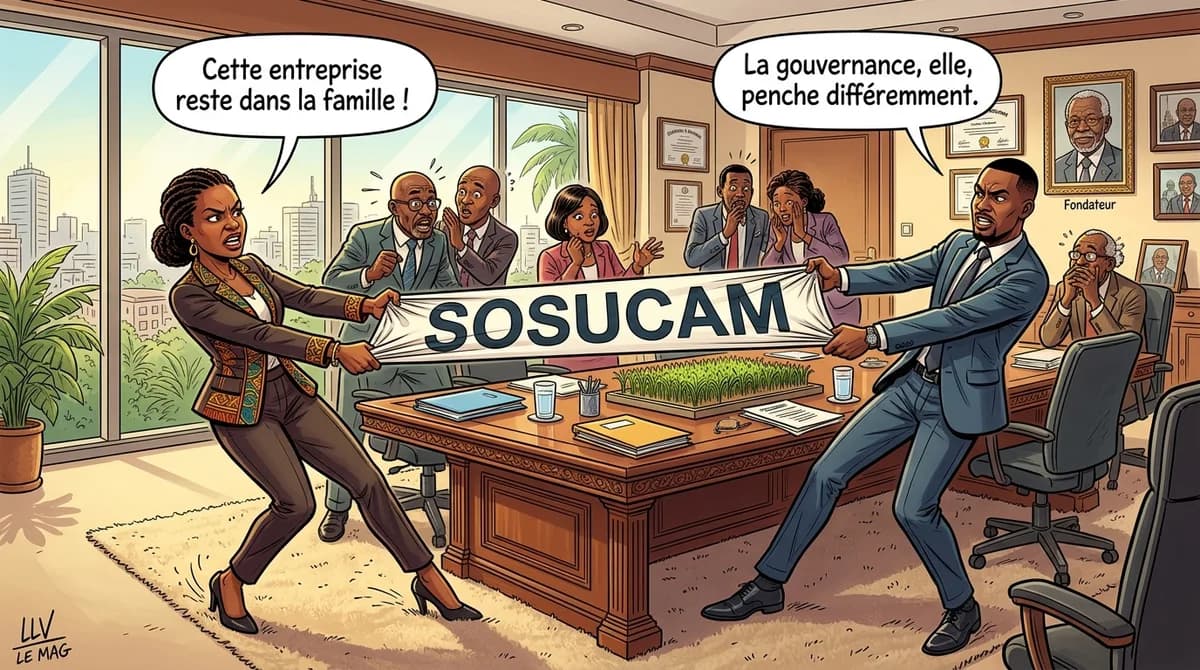
On June 22, 2026, Romy Castel voiced her disagreement with the sale of the shares held by Somdia in the Cameroon Sugar Company (Sosucam). The opposition comes amid a process launched by Somdia and overseen by the Cameroonian government, aimed at transferring the French group’s stake in one of the country’s largest agro‑industrial enterprises.
Sosucam, a leading player in Cameroon’s sugar sector, is owned by Somdia, a subsidiary of the Castel Group, one of the world’s largest agri‑food conglomerates. DF Holding, the parent company of the Castel Group, oversees the group’s strategic decisions and ensures governance consistency worldwide. The proposed sale therefore involves Somdia’s shares, which would be transferred to new investors or to other entities within the group.
Romy Castel, daughter of founder Pierre Castel, argues that the sale threatens the stability of Cameroon’s sugar industry and undermines commitments made to employees and local communities. She also invokes the principle of transparency, reminding that any such transaction should be preceded by consultation with stakeholders, notably Cameroonian authorities and workers’ representatives.
In response to these accusations, DF Holding and Somdia contend that the decision aligns with the Castel Group’s overarching vision, which prioritises rigorous governance and asset optimisation to ensure long‑term competitiveness. They stress that the sale is not a divestment but a restructuring aimed at strengthening the sugar value chain, while complying with Cameroon’s legal and regulatory requirements.
For Cameroonian economic observers, the debate is of critical importance. The sugar sector employs several thousand workers and accounts for a significant share of agricultural exports. Any change in the shareholding structure could affect future investment, production capacity, and price stability for farmers. The risk of perceived instability could also deter additional foreign capital at a time when the country is seeking to diversify its economy.
Politically, the government’s role in overseeing the process is being closely watched. A decision perceived as imposed without consultation could fuel a sense of opaque governance. Conversely, a consensual outcome would bolster confidence in Cameroonian institutions and demonstrate the country’s ability to manage large‑scale transactions transparently.
The coming days will be decisive. If Romy Castel manages to rally sufficient support, the sale could be reconsidered or conditioned on additional safeguards for employees and local communities. If not, DF Holding will press ahead with its plan, relying on the group’s governance framework. In any case, dialogue between the parties must intensify to avoid a stalemate that could jeopardise the future of Cameroon’s sugar sector.