
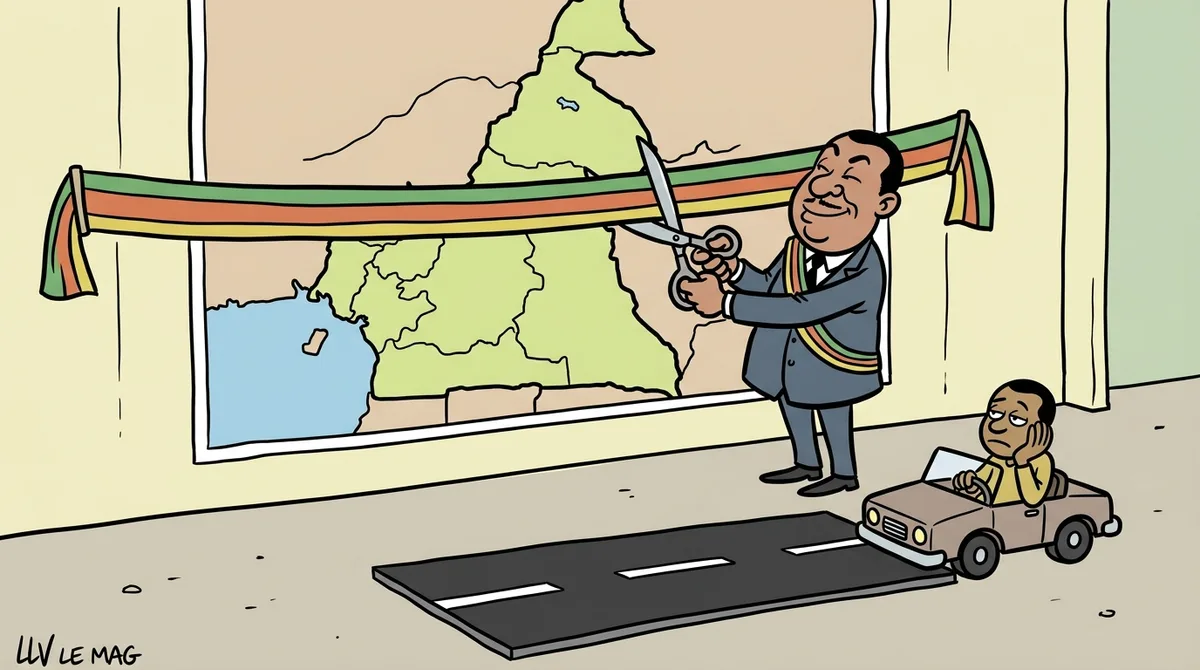
On July 14, 2026, the Cameroonian government confirmed an ambitious project: the creation of roughly 400 kilometres of regional‑interest roads in the South, aimed at ending the isolation that has hampered local development for decades.
South Cameroon, rich in natural resources and cultural diversity, nevertheless suffers from a fragmented road network. Remote villages struggle to reach markets, health services and schools, fueling poverty and driving migration to the big cities.
During a hearing held the same day, a delegation led by Ms. Bisse Meba Cathy, Vice‑President of the South Regional Council, met with the Minister of Public Works, Emmanuel Nganou Djoumessi. The de‑isolation programme was presented, highlighting the need for preliminary studies to ensure the technical and financial viability of the project.
The delegation welcomed the investments already made by the government, notably the progress on the Ebolowa–Akom II–Kribi road and the rehabilitation of the Ebolowa–Ambam route. These two corridors, nearing completion, illustrate the commitment to improve service to the territory and give local populations a first breath of hope.
The de‑isolation plan foresees the construction of nearly 400 km of roads classified as ‘regional interest’. Minister Nganou Djoumessi reiterated his ministry’s readiness to support the region in carrying out the preliminary studies, a prerequisite for mobilising the necessary funding and securing project implementation.
In concrete terms, the new roads should cut travel times by several hours, facilitate the transport of agricultural produce to the ports of Kribi and Douala, and improve access to healthcare for rural residents. Better connectivity could also boost tourism by making the South’s natural sites more accessible to national and international visitors.
However, the programme’s success will depend on the government’s ability to unlock funds, ensure transparency in tendering processes and guarantee the quality of the works. Technical challenges, such as rugged terrain and climatic conditions, require specialised expertise and strict supervision to avoid delays and cost overruns.
Local observers are keenly awaiting the first results of the feasibility studies, which will determine the final alignments and intervention priorities. Regular monitoring, involving local authorities, technical partners and communities, will be essential to turn these promises into tangible outcomes.
If the project materialises, South Cameroon could become a model of infrastructure revival in Francophone Africa, demonstrating that targeted investments backed by strong political will can break the cycle of exclusion and stimulate inclusive growth.