
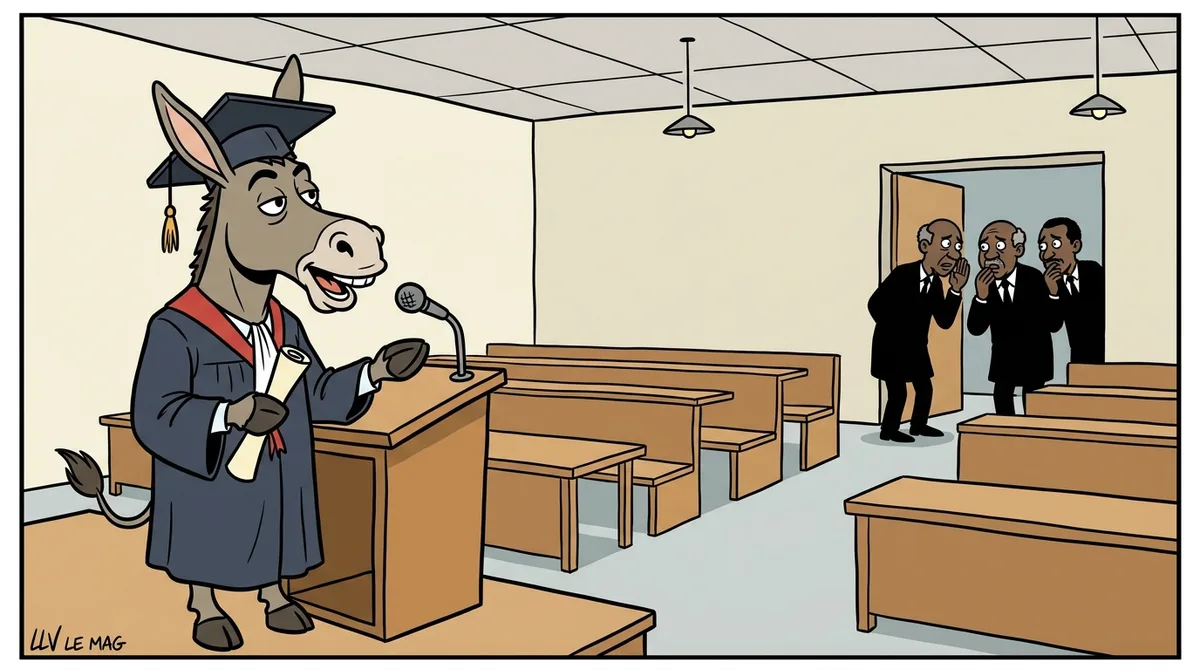
On July 14, 2026, the Journal du Cameroun reproduced a virulent statement: 'Cameroonian academics are driven by fear and selfishness.' This claim, taken from a piece by Jean‑Lambert Nang titled 'Better a donkey than a professor,' immediately raises a crucial question: what lies behind this observation?
First, the fear mentioned is not merely an individual apprehension. It is embedded in an institutional climate where reforms, political pressure and budgetary uncertainties create an atmosphere of doubt. Researchers, often dependent on public funding, may hesitate to tackle sensitive topics, fearing repercussions. Such reticence hampers innovation and the production of knowledge essential for the country's development.
Second, the selfishness attributed to academics, according to the author, manifests as a priority given to personal interests—career advancement, excessive publishing—at the expense of the university's social mission. This critique echoes a broader debate on academic governance: the pursuit of international recognition can sometimes obscure local needs, such as training technicians suited to key sectors of Cameroon's economy.
Nang's text, though controversial, highlights a structural problem: the split between the hard sciences and the humanities. The journalist reminds us that universities tend to differentiate 'hard sciences,' often seen as more directly useful, from disciplines considered more abstract. This divide fuels the perception that certain programmes are 'unnecessarily' funded, reinforcing a sense of irrelevance.
The consequences for students and society are tangible. A climate of fear can lead to reduced participation in applied research projects, limiting employment opportunities for recent graduates. Moreover, an emphasis on individual selfishness risks eroding academic solidarity, which is essential for building research networks capable of tackling national challenges such as public health or the energy transition.
In response to these findings, several avenues for improvement emerge. First, greater transparency in the allocation of university resources could ease tensions and foster a culture of collective responsibility. Second, strengthening tripartite partnerships—state, private sector and universities—would provide more stable funding frameworks, reducing reliance on volatile subsidies. Finally, valuing projects with local impact, even in disciplines deemed 'theoretical,' would help reconcile academic excellence with societal relevance.
Ultimately, the debate sparked by the Journal du Cameroun should not be reduced to a simple diatribe against academics. It is a call to rethink the role of higher education in a country undergoing rapid change. While fear and selfishness are realities that need to be addressed, they can become catalysts for institutional renewal, provided that stakeholders—authorities, faculty and students—engage in a constructive dialogue focused on the future.