
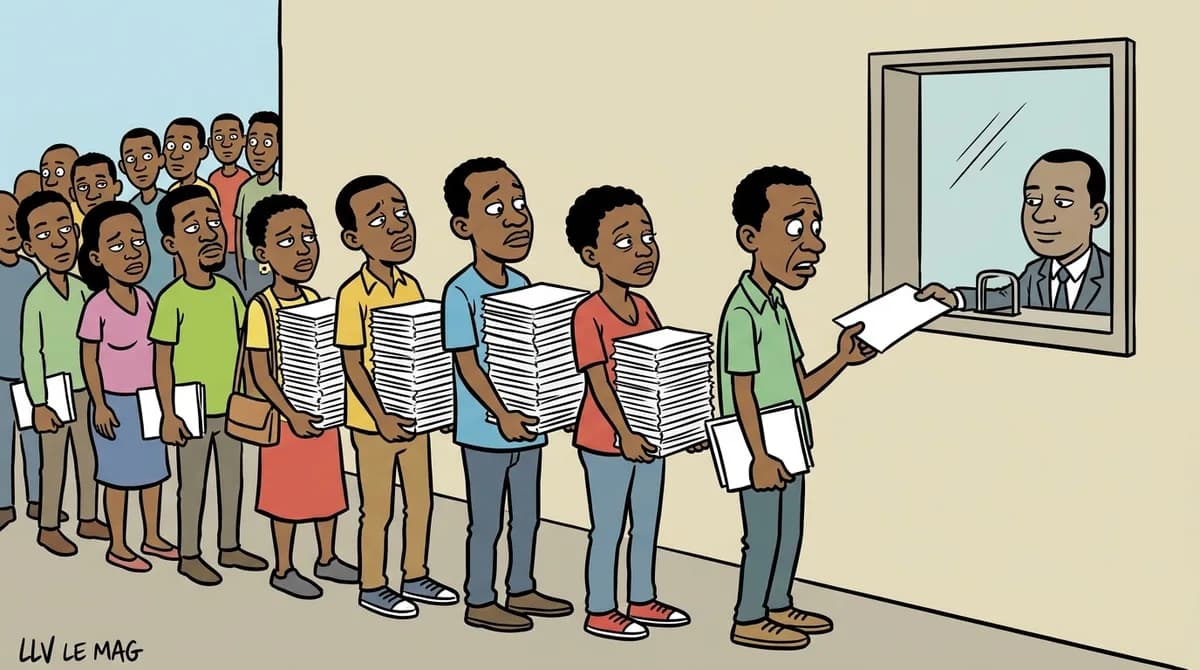
On Tuesday, July 14, 2026, the square in front of the French embassy in Yaoundé filled with determined faces and protest signs: several dozen students and their supporters marched peacefully to denounce the new financial requirements imposed on applicants seeking to continue their studies at a French private institution.
Since July 9, Campus France Cameroon announced that, before any visa is issued, applicants must now provide proof of full payment of their tuition fees or demonstrate that they have the necessary funds. This unexpected measure adds to the already burdensome student‑visa application process.
For Yvan Odjo, a candidate for a Master 2 in public law at a French private university, the rule is a major hurdle: “I’m already enrolled, I’ve submitted my file, and now they’re asking me to prove I’ve already paid,” he said, highlighting the sense of injustice spreading among young Cameroonians aspiring to study abroad.
The crux of the issue lies in the financial capacity of Cameroonian families. According to the latest estimates from the Ministry of Education, the average cost of a year at a French private institution exceeds €15,000, an amount that few households can muster without resorting to loans or external assistance. Requiring proof of payment before even obtaining the visa thus widens an already existing gap between the elite and the majority.
This new requirement could deter thousands of applicants, especially since the number of visas granted to Cameroonian students was already deemed “low” by local student associations. A further reduction in the flow of students could impact the return of expertise, academic cooperation, and even employment prospects in sectors where overseas training is valued.
In this context, yesterday’s demonstration is not merely a protest cry but a call for transparency and a revision of the criteria. The protesters demand the suspension of the measure until a fair solution is found, urging French authorities to consider installment payment options or scholarships accessible to deserving candidates.
Developments remain to be seen. Campus France has not yet issued an official response to the mobilization, and students await an answer that could redefine the conditions for accessing French higher education. In the meantime, the mobilization shows that Cameroonian youth will not passively accept barriers that jeopardize their academic future.